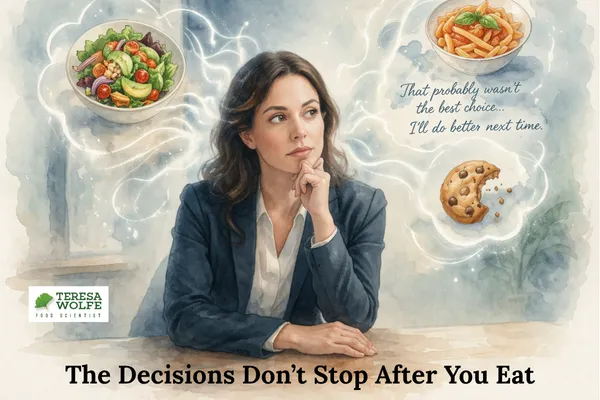
The Decisions Don’t Stop After You Eat
YOU MAKE A DECISION about what to eat.
You eat the meal. And technically, that should be the end of it.
But a lot of the time, it isn’t.
Later, it comes back in small ways. You find yourself thinking about it again… wondering if it was the right choice, or already thinking about how you’ll do it differently next time.
It’s not overwhelming. It’s just… still there.
And over time, that starts to wear on you.
(There’s a reason for that—our brains handle fewer decisions well as the day goes on, especially when we’re already managing a lot. Cleveland Clinic explains it simply here.)
Not because you don’t know what to eat. Most clients I work with know plenty.
It’s that food keeps taking up more space in your day than it should.
You’re not just eating. You’re thinking about it before, during, and after. You’re carrying it forward into the next decision.
(This is the same pattern I wrote about in The Hidden Cost of Second-Guessing Every Food Choice.)
And that’s where it starts to feel… pesky. Like the nagging itch of a mosquito bite—only harder to ignore.
(If you’ve ever hit that point where your brain is done by dinner, I wrote more about that here.)
For a lot of capable adults, this is often the one place that doesn’t feel as solid as the rest of your life.
Not publicly. Not in a way anyone else would notice.
But internally, it’s often the one area that doesn’t feel as clear, as steady, or as handled as everything else.
Sometimes it’s where you stop pushing for a clean decision.
Or where you give in just to be done thinking about it.
Not because you don’t care—but because you’re tired of carrying it.
Every once in a while, though, something different happens.
You eat a meal, and you’re done.
You don’t revisit it later. You’re not adjusting for it at the next meal. You just move on with your day.
And there’s a quiet sense of relief in that. Like something finally settled.
That’s really what most people are looking for.
Not a perfect way to eat. Not a complicated set of rules or a restrictive diet.
Just a way for food to feel like it’s supposed to feel… nourishing.
If this is happening for you, it’s worth taking a closer look at how your food decisions are actually happening.
I created a short guide to help you see what’s going on—and why your decisions don’t feel finished.
📥 Download the Personalized Dietstyle Discovery Guide and start there
A simple place to start, so food can take up less space in your day—and you can get some of that energy back.
This isn’t about eating better. It’s about making fewer, clearer decisions.
