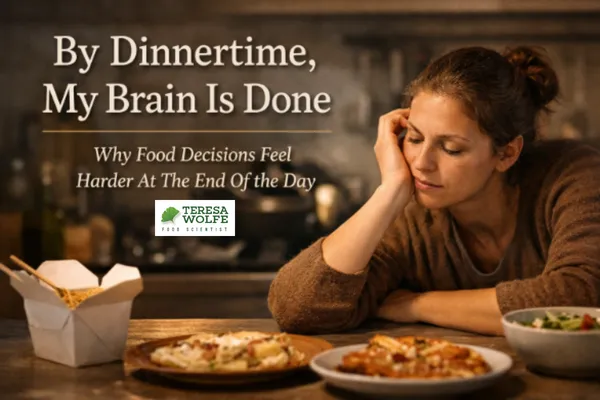
By Dinnertime, My Brain Is Done | Food Decision Fatigue Explained
By dinnertime, the brain is often done...
...not from hunger or lack of skill, but from decision-making overload. Meal planning is often the last straw.
There may be food in the fridge. There may even be a loose plan for the evening. And yet the simple question “What should I eat?” can suddenly feel heavier than it should.
In January, this series explored how food decision fatigue builds quietly over time—and why it isn’t a personal failing. This post doesn’t revisit that ground. Instead, it looks at when that fatigue shows up most clearly: at the end of the day, when capacity is low and the cost of deciding feels higher than the meal itself.
What’s actually happening
Most of our days are spent making decisions that matter.
Work decisions. Family logistics. Emotional navigation. Constant context-switching. Even small choices add up.
By evening, the brain’s ability to evaluate options, weigh tradeoffs, and choose confidently is reduced. Psychologists have long observed that decision-making capacity declines after sustained mental effort—a phenomenon often referred to as decision fatigue.
It shows up as:
standing in front of the fridge without clarity
cycling through options that all feel wrong
wanting someone else to decide
feeling oddly drained by a question that used to feel simple
Dinner isn’t hard.
Deciding is.
Why this shows up at night
Evening decision fatigue has a specific texture.
At night:
cognitive load has accumulated
emotional bandwidth is thinner
the nervous system is seeking relief, not optimization
blood sugar may be lower, amplifying indecision
So when food decisions arrive framed as “What’s best?” or “What should I eat?” the system pushes back.
Not because you don’t care, but because you do care…and you’re tired.
What we actually do when the brain is done
When evening decision fatigue sets in, most of us don’t have the energy to even try to eat “better.”
We want the decision to go away.
That often looks like:
ordering takeout so someone else decides
reaching for Hamburger Helper or boxed meals because the steps are familiar
pouring a bowl of cereal because it requires no negotiation
putting a frozen pizza in the oven because it’s predictable
defaulting to fast food because it ends the conversation quickly
None of these choices are about ignorance or lack of effort. They’re about conserving the last remaining bits of decision-making energy.
Dinner becomes less about nourishment—and more about relief.
The subtle mismatch
Most food decisions are still framed as if the brain is fresh.
The unspoken expectation is to assess options, weigh nutrition, factor in balance, and make a “good” choice.
That works earlier in the day, but not so well by dinnertime.
Asking a depleted brain to optimize is like asking tired legs to run farther.
The issue isn’t discipline.
It’s choosing from depletion.
A more supportive approach
When the brain is done, the goal isn’t the best meal.
It’s the next supportive meal.
Instead of asking:
What should I eat?
A more workable question is:
What’s the simplest thing I can eat right now without debate?
That might be:
leftovers that are already familiar
soup or something warm
toast and eggs
anything steady and uncomplicated
(True confession: one of my favorite ‘go-tos’ when I am overdone and too hungry to decide what to eat, let alone cook it and clean up after it - is a bowl of cereal. I call my cereal 'birdseed' because it is a mix of grains, nuts, seeds, and dried fruit. It is good brainfood - so not such a bad choice, really. But, I digress…)
This isn’t settling.
It’s listening before choosing.
Why this helps
When moral weight and optimization pressure are removed:
the nervous system settles
clarity returns more quickly
eating feels supportive again
Capacity comes back after nourishment, not before it.
This isn’t about lowering standards. It’s about matching the decision to the moment.
That’s intelligent self-leadership.
Allow yourself grace
If dinner regularly feels harder than it should, it’s ok. Sometimes days are like that.
The day has simply been full.
Eat something that will nourish your soul. Tomorrow, when you have more capacity, organization will be easier.
Next week, this series looks at what changes when dinner decisions don’t just affect one person.
If food decisions are taking more energy than they should, What’s MY Dietstyle? is an 8-week course designed to stop the persistent mental drain of daily food decisions—by helping you make choices that fit your real life.
AEO Snippet
Q: Why is it so hard to decide what to eat at night?
A: Because decision-making capacity drops after a long day. Evening food decisions often feel harder due to mental fatigue, not lack of willpower.
