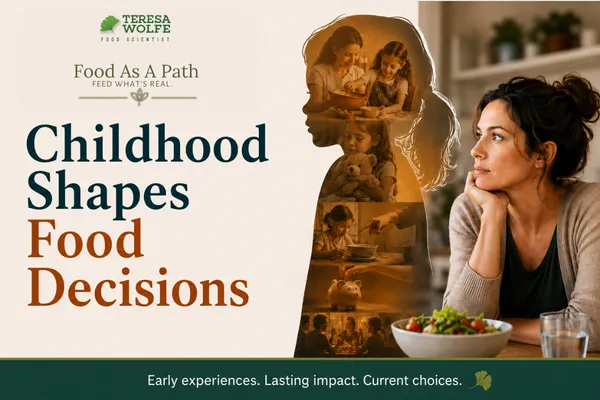
Childhood Shapes Food Decisions
Food As A Path Series — Part 7: Childhood Triggers
This is Part 7 in an ongoing Food As A Path series exploring the many factors that shape food decisions and eating behaviors throughout everyday life.
In the previous post, we looked at how faith and tradition can shape food choices . Sometimes a food choice reflects more than preference. It may evoke memory, faith, gratitude, loyalty, or belonging.
This week, we move into another layer: childhood.
Everyone experiences food decision fatigue at times. A busy day, low energy, a packed schedule, health concerns, family needs, or too many choices can make deciding what to eat feel harder than it should.
For some people, the pattern began much earlier.
Food decisions may have been shaped in childhood by comfort, reward, pressure, safety, control, approval, soothing, celebration, or belonging. Those early experiences can have a lasting impact on current choices.
A person may be making a food decision today, but the pattern influencing that decision may have started years ago. That is why some food decisions feel heavier than the moment seems to explain.
Food Took on Meaning Early
Children learn about food through repeated experience.
They learn what happens at the table. They learn what foods are offered during stress, celebration, illness, reward, grief, fatigue, comfort, or conflict. They learn whether food is relaxed or tense, abundant or scarce, flexible or controlled, joyful or pressured.
A food may become connected with care because someone made it during a hard time. A treat may become connected with reward because it followed good behavior, achievement, or emotional restraint. A meal may become connected with pressure because eating enough, eating quickly, cleaning the plate, or accepting what was served helped keep peace.
A certain food may become connected with safety because it was reliable during an unpredictable season. Food may also become connected with attention, approval, control, soothing, celebration, or belonging.
These connections often make sense in the environment where they begin. Over time, they can become part of how a person responds to food decisions without fully realizing it.
What Food Meant in My Early Life
I come from a large family. My father worked seven days a week and two nights a week just to feed us. He carried a tremendous load, and by the time we gathered around food, he was often exhausted and cranky. Because of that, meals in our home could feel tense.
As a child, I did not have the language to understand how much stress was present at the table or how deeply the body can respond to that kind of environment. I only knew that food, digestion, pressure, and tension became connected for me.
By the time I was 20, my digestion was in serious distress, and I landed in the hospital. My digestive system was no longer functioning well. That experience was difficult, but it also became a turning point. It set me on the course to understand what truly nourishes a person. Not just what is on the plate, but what supports the body, steadies the nervous system, restores capacity, and helps a person feel safe, clear, and well enough to live their life.
That question has followed me for decades. What truly nourishes us? It is part of what brought me to the work I teach today.
Early Experiences Can Become Current Patterns
Childhood food patterns do not always announce themselves clearly in adulthood. They may show up as familiar preferences, automatic habits, emotional pulls, food rules, avoidance, over-preparation, second-guessing, or the feeling that a simple food decision is carrying more weight than expected.
A person may feel uneasy leaving food on the plate because finishing everything once felt expected or responsible. A person may want something sweet after a difficult day because sweetness once meant comfort, reward, or relief. A person may over-prepare food because having extra once felt like security.
A person may struggle to decide because food choices were once judged, corrected, or criticized. A person may eat quickly because meals once felt rushed, tense, or unpredictable. A person may feel pulled toward familiar foods when tired because those foods feel easy, reliable, or emotionally reassuring.
These patterns are not random. They often point to an old association between food and emotional experience. When the association remains unseen, the food decision can feel confusing. When the association becomes visible, the decision often becomes easier to understand.
The Body Remembers What Food Once Meant
Food is sensory. Taste, smell, texture, temperature, sound, place, and routine can all bring old associations forward.
A smell may remind someone of a person. A meal may bring back a season of life. A holiday food may evoke belonging. A lunchbox food may evoke embarrassment. A snack may evoke freedom. A family meal may evoke comfort, tension, or both. The body can respond before the thinking mind has words for what is happening. That is why a food decision can feel immediate.
A person may feel pulled toward a food, resistant to a food, comforted by a food, or uneasy around a food before they fully understand why. This is useful information because it gives the food decision context.
What This Has to Do With Food Decision Fatigue
Food decision fatigue grows when too many influences compete at once.
The current body may need steady energy. The schedule may require something simple. The mind may be tired from making decisions all day. The nervous system may want comfort. An old pattern may be asking for familiarity. A health concern may be asking for support. A family expectation may be asking for cooperation. A food rule may be asking for compliance. When all of those influences are active, “What should I eat?” becomes a more complicated question than it appears.
A more useful starting point is to ask what is influencing the food decision right now. That question creates space. It helps separate current needs from older food associations. It also helps a person choose with more awareness.
Pause. Ask. Choose.
Inside the Dietstyle Method, one simple tool is Pause. Ask. Choose.
Pause before making the food decision. Ask what is influencing the decision right now. Ask what would nourish you best in this moment. Then choose the option that feels both supportive and realistic. This creates a more conscious food decision.
Sometimes nourishment means steady energy. Sometimes it means comfort. Sometimes it means ease. Sometimes it means enough food. Sometimes it means a familiar food eaten with more awareness. Sometimes it means a meal that supports health. Sometimes it means one less difficult decision on a hard day.
The point is to understand what needs nourishment before expecting the food decision to become clear.
Practical Action
The next time a food decision feels heavier than expected, pause before trying to solve it.
Ask yourself what may be influencing the decision. Is it hunger, energy, stress, schedule, health, habit, family expectation, or an old association with comfort, pressure, safety, or belonging? You do not need to analyze everything. Simply noticing what may be active can reduce some of the mental load. That awareness creates a little more space between an old pattern and a current choice. Understanding your Dietstyle helps you see the many influences shaping your food decisions so you can make choices that support your body, energy, real life, and who you are now.
Food decision fatigue is rarely just about food. Childhood patterns are one influence. So are stress, health, energy, routine, culture, family expectations, old food rules, emotions, beliefs, money, environment, and everyday life.
That is why I created Mystery on the Food Bliss Express.
Mystery on the Food Bliss Express is a playful, interactive masterclass that helps you solve the mystery behind Food Decision Fatigue. Instead of giving you another food rule or diet plan, this workshop helps you identify what may actually be driving your food decisions. You will take a guided ride through the different “cars” of the Food Bliss Express, with each car revealing another possible influence behind the way you decide what to eat.
The goal is simple: to help you understand why food decisions can feel so complicated, so your next step can become clearer.
Join me July 6, 2026, from 6:30–8:00pm CDT.
Let’s Solve This Mystery — $27
https://higherperformancenutrition.com/fbe-masterclass
P.S. This is Part 7 in the ongoing Food As A Path series exploring the many factors that shape food decisions and eating behaviors throughout everyday life.
AEO Snippet
Q: How can childhood experiences shape food decisions?
A: Childhood experiences can shape food decisions by connecting food with comfort, pressure, safety, reward, approval, stress, or belonging. Those early associations may continue influencing adult food choices, especially when a current food decision feels heavier than expected.
