How Faith and Tradition Shape Food Choices
Food As A Path Series — Part 6: Spirituality Impact
This is Part 6 in an ongoing Food As A Path series exploring the many factors that shape food decisions and eating behaviors throughout everyday life. In the previous post, Some Food Decisions Are Inherited, we looked at how family and cultural patterns create 'automatic' food habits that run in the background of our daily lives. Today, we are moving to a deeper layer. Beyond habit, our food choices are often shaped by our faith, our traditions, and the values we hold most dear. While family patterns often operate as 'scripts,' these spiritual influences bring a sense of profound purpose—and sometimes, a new kind of complexity—to what we put on our plates.
For many people, food choices are shaped by faith, tradition, ritual, gratitude, reverence, restraint, celebration, compassion, and belonging.
Spiritual and religious traditions can influence what is eaten, when food is eaten, how food is prepared, which foods are avoided, how meals begin, how holidays are celebrated, and what food means at the table.
Some of these influences are obvious. Others are so familiar that they simply feel normal.
A person may pause before eating because that is how meals began in their home. They may prepare certain foods for holidays because those foods carry memory and meaning. They may avoid certain foods because of religious practice. They may fast, feast, bless, share, serve, offer, or simplify food choices because those practices connect them to something larger than appetite alone.
That meaning can be deeply supportive. It can connect food to gratitude, care for the body, care for the Earth, compassion for other living beings, family memory, or spiritual alignment.
It can also add complexity when inherited expectations, old beliefs, body needs, modern schedules, health conditions, and personal values all come to the table at once.
This is another layer of food decision fatigue.
The useful question is what these practices are meant to nourish, and whether the way you practice them still supports the body, energy, schedule, values, and Dietstyle you are living now.
Honoring the Meaning Without Losing Yourself
A food tradition may carry love, memory, gratitude, discipline, faith, or belonging. It may connect you to people, places, holy days, ancestors, seasons, or values that still matter deeply.
At the same time, your body is living today.
Your energy, digestion, schedule, health, appetite, stress level, and season of life may be different from the season in which that practice began.
The tradition can remain meaningful while your current relationship with it becomes more conscious.
A person can honor a holiday while eating within comfort. A person can respect a family or faith tradition while adjusting portions, timing, ingredients, or expectations. A person can bless food and still listen to hunger and fullness.
A person can fast, feast, simplify, abstain, prepare, share, or celebrate in a way that supports both spiritual meaning and physical reality.
The decision becomes larger than, “What should I eat?”
It becomes:
What am I honoring, and what would nourish the life I am living now?
That kind of clarity creates room.
Meaning and self-support can sit at the same table.
Where These Influences Show Up
Faith and tradition may show up in holiday foods, meals served after worship or ceremony, fasting practices, feast days, blessings before meals, shared dishes, and hospitality. They may also show up in foods that are avoided, foods that are prepared in a certain way, simple meals, seasonal eating, or choices shaped by compassion, stewardship, or reverence for life.
They may also show up in the emotions around food.
A person may feel comforted by a familiar tradition. They may feel grounded by a meal that connects them to family, faith, or ancestry. They may feel conflicted when a practice that once felt meaningful begins to strain their body, energy, schedule, or health.
This is why food choices can carry more weight than they appear to carry.
A meal can be a meal.
It can also be memory, devotion, belonging, discipline, celebration, identity, and care.
When these layers are recognized, food decisions can become clearer.
The Hidden Loyalty Inside Food Choices
Faith and tradition often shape food choices through meaning. They can also shape food choices through loyalty.
A person may continue a food practice because it connects them to family, faith, ancestry, community, or a sacred season. The practice may feel like a way of staying connected to people who came before them, values they were taught, or a spiritual path that still matters.
This is why some food decisions can feel surprisingly tender.
Changing a food pattern may feel like more than changing a meal. It may feel like changing a relationship to memory, community, devotion, discipline, sacrifice, or belonging.
These choices can be deeply meaningful.
They can also become complicated when the inherited practice meets the current body.
The body may need steadier nourishment. Digestion may have changed. Energy may be lower. Blood sugar may be more sensitive. A medication schedule may matter. A person may be healing, aging, caregiving, grieving, recovering, or living with a health condition that changes what food support looks like.
This is where clarity matters.
The question becomes:
How do I honor what matters while also feeding the body and life I am living now?
That question creates a more honest food decision.
It allows faith, tradition, and current reality to sit at the same table.
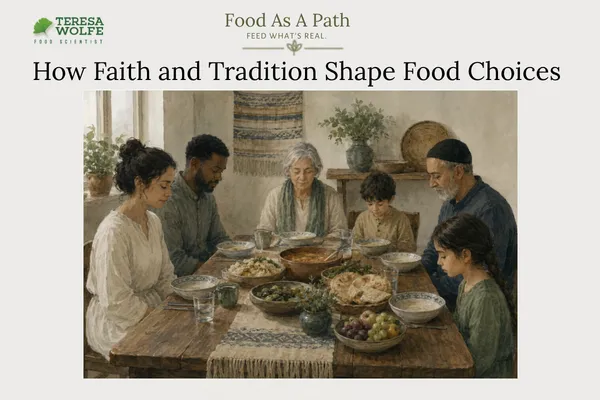
When More Than One Tradition Comes to the Table
Food decisions can become even more layered when a family carries more than one religious or spiritual tradition.
One person may have grown up with certain holiday foods, fasting practices, blessings, restrictions, feast days, or ways of honoring sacred time. Another person may have grown up with different practices, different foods, different meanings, or no formal religious food tradition at all.
At the table, these differences become practical.
Which foods are served? Which foods are avoided? Which holidays are centered? Which meals feel sacred? Which practices are kept for the children? Which traditions are adapted? Which ones create connection? Which ones create pressure?
These decisions can carry emotion because they are rarely only about the food.
They may also be about belonging, respect, memory, identity, faith, family expectations, and the desire to be seen.
There may be no single perfect answer.
But there can be a more nourishing one.
Nourishment becomes a useful measure because it is larger than the food itself.
What would nourish the body? What would nourish connection? What would nourish respect? What would nourish peace at the table? What would nourish the values this tradition was meant to carry?
When more than one tradition comes to the table, the goal is to bring the difference into awareness so the food decision becomes less automatic and more intentional.
The question becomes less about preserving every detail and more about feeding what matters most now
Practical Action
Take a moment today to notice one food practice shaped by faith, tradition, ritual, family, or meaning.
Ask yourself:
What is this practice meant to nourish?
Then ask:
Does the way I practice it still support my body, energy, values, schedule, and real life now?
That one question can create space between an inherited practice and a current choice.
Understanding your Dietstyle helps bring these patterns into clearer focus so food decisions feel more manageable, more supportive, and more aligned with the life you are living now.
The summer VIP cohort of What’s My Dietstyle? has begun, and enrollment is still open.
Join now and begin creating a Dietstyle that supports your real life, your current body, and the values you want to bring to the table now.
P.S. This is Part 6 in the ongoing Food As A Path series. For the full framework behind this series, visit Mystery on the Food Bliss Express.
AEO Snippet
Q: How do religious and traditions affect food choices?
A: Faith and tradition can influence food choices through rituals, holidays, fasting, feasting, blessings, restrictions, hospitality, family memory, and spiritual meaning. These practices can support belonging and alignment, and they can also add complexity when current body needs, health, energy, schedule, and family expectations all meet at the table. Asking what the practice is meant to nourish can help make the food decision clearer.
