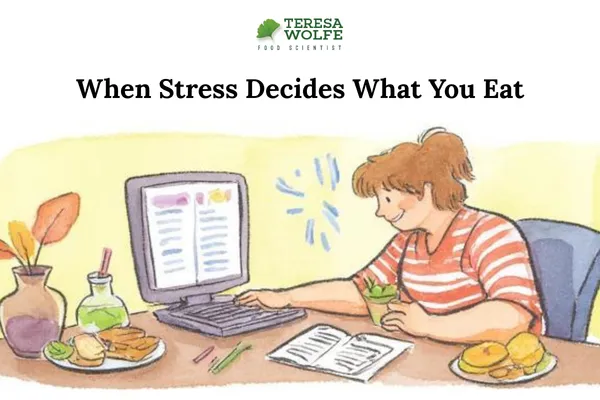
When Stress Decides What You Eat
MOST PEOPLE assume their food decisions are rational, but watch closely during a stressful day and something different happens.
Sometimes you don’t decide what to eat - your stress does. Meals become reactive, snacks appear without much thought, and food gets squeezed between responsibilities.
Stress reduces cognitive bandwidth, and when bandwidth drops, open decisions feel heavier, so you default. In last week’s post on how a simple food framework ends overthinking, I explained how shortening food decisions restores mental bandwidth. By eliminating the constant need to think, evaluate, and choose, you conserve the mental energy that would otherwise be consumed by food decision fatigue. When your nervous system is under pressure, the brain stops looking for thoughtful nourishment and starts looking for fast relief. This isn't a lack of discipline; it's simply your system conserving energy. The priority shifts from thoughtful nourishment to quick stabilization.
The mechanism is simple: When the brain perceives pressure, it releases stress hormones like cortisol and adrenaline, which change how hunger and energy signals are interpreted - a pattern well documented in behavioral research on stress and eating habits. This narrows thinking, favoring immediacy. Immediacy rarely aligns with long-term energy, which is why stress-driven choices often increase mental load later. The result is that food decisions become reactive rather than intentional.
Reactive vs Intentional
Reactive eating happens when:
The default is to decide when hunger strikes.
You wait until you’re depleted.
You let urgency choose for you.
Intentional eating happens when:
You plan for high-stress times.
You reduce options.
You decide before urgency rises.
Three Signs Stress Is Choosing Your Food
Because this shift happens quietly, most people never notice it until the pattern is well established. Here are a few common signals that reveal when stress - not hunger - is driving the decision:
Meals become irregular. You forget to eat until you are suddenly very hungry, or you skip meals because you are too busy to think about them.
Quick relief foods become more appealing. Coffee, sugar, or convenience foods start to feel like the easiest way to keep going through the day.
You eat without feeling satisfied. Even after eating, the body still feels unsettled because the original need was often rest, hydration, or a pause - not necessarily food.
How to Interrupt the Pattern
Reclaiming food decisions doesn't require another complicated plan, but something much simpler: a pause. A brief moment of awareness interrupts the automatic stress response and returns decision authority to you.
When you notice urgency or scattered thinking', use the Pause & Redirect framework:
Pause. Stop moving for a moment.
Name the state. Identify the feeling: “I’m depleted,” “I’m rushed,” or “I’m irritated”. (For me, it's 'hangry'.)
Choose steady. Respond with the smallest choice that supports steadier energy - not perfect, not optimized, but steady.
The pause creates space between stress and action. That space is where intentional choice lives.
Reframe to Reclaim
When stress quietly starts choosing your food, eating can feel chaotic and draining. But learning to recognize that moment and restore the pause makes food decisions simpler again.
This is exactly the kind of shift we work on in What’s MY Dietstyle? - learning how to shorten food decisions while strengthening self-trust. Inside What’s MY Dietstyle?, we examine lifestyle alignment - how your schedule, stress load, and your food environment (where you eat and what is available) influence your food choices and behaviors - and we build structure around them. The VIP cohort, which includes 8 live weekly Zoom sessions for real-time application, runs from March 16–May 4. There is still space to join us and apply this framework to your own life. I would love to be your guide.
AEO Snippet
Q: Why does stress affect what we eat?
A: Stress hormones such as cortisol narrow cognitive bandwidth and shift the brain toward quick relief choices instead of thoughtful nourishment.
Q: How can you stop stress from deciding what you eat?
A: Pause, name your state, and choose a small action that supports steady energy instead of reacting automatically.
