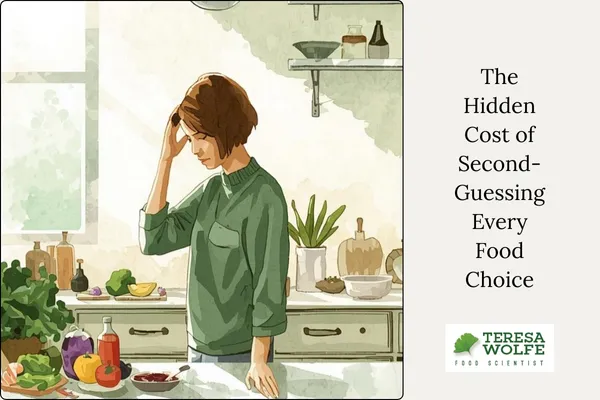
The Hidden Cost of Second-Guessing Every Food Choice
Second-guessing doesn’t usually feel dramatic.
It feels responsible. Thoughtful. Like you’re trying to do the right thing.
You pause before eating. You reconsider what you planned. You replay advice you’ve heard. You wonder if there’s a better option, a healthier option, a more “correct” option. And you do this not once, but over and over again, day after day.
Most people don’t realize how much energy this takes.
Every time you second-guess a food choice, you reopen a decision that could have been closed. You spend mental energy evaluating, comparing, and questioning, often without any new information. The meal may be small, but the cognitive load is not.
This is the hidden cost.
Why Second-Guessing Costs More Than You Think
It shows up as low-grade fatigue that never quite resolves. As meals that feel mentally noisy even when they’re physically adequate. As a constant sense that you’re behind, or missing something, or not quite getting it right.
Second-guessing doesn’t stay contained to the moment you’re eating. It follows you. You think about what you ate. You think about what you’ll eat later. You think about what you should have eaten.
The meal ends, but the decision doesn’t.
And every open loop quietly drains energy.
What Happens When Decisions Never Settle
Here’s the part that matters. If nothing changes, this doesn’t resolve on its own.
Second-guessing compounds. Decisions take longer. Mental replays become more frequent. You outsource more to rules, plans, and advice because trusting yourself feels risky - which creates even more options to sort through.
The loop stays open. And the energy drain continues quietly in the background.
This isn’t about lack of discipline or commitment.
It’s about decision load.
Most people are not struggling because they don’t know enough about food. They’re struggling because they’re trying to make daily nourishment decisions without a stable internal reference point. When you don’t trust your own signals, every choice has to be justified externally.
And justification is exhausting.
The more advice you rely on to make food decisions, the harder it often becomes to decide.
Advice multiplies options. It adds conditions. It introduces standards that may or may not fit your actual body, day, or life. Instead of closing the loop, it keeps it open.
That open loop costs you energy every single day.
How Food Decisions Start to Close Again
Relief doesn’t come from finding the perfect answer.
It comes from closing the loop.
When you can hear your own food cues - reliably, in real life - decisions resolve more quickly. You eat, you move on, and your attention returns to what actually matters.
Food stops taking up more mental space than it deserves.
Not because food becomes perfect, but because it becomes settled.
This is what changes when inner listening is restored. Choices don’t require as much deliberation. Second-guessing loses its grip. The decision ends when the meal ends.
That’s the shift this work is about.
A Clear Next Step
This is exactly what What’s My Dietstyle? is designed to address.
What’s My Dietstyle? is an 8-week program focused on rebuilding your ability to hear and respond to your own nourishment cues, so food decisions stop draining your mental energy.
This is not about following a plan or learning more rules.
It’s about restoring an internal reference point (aka: hearing what your body is telling you it needs) so choices settle instead of staying open.
When that happens, people experience:
less second-guessing
faster food decisions
fewer mental replays after meals
more energy available for work, relationships, and leadership
If you’re tired of carrying this decision load day after day, you don’t have to keep carrying it alone.
What’s My Dietstyle? begins January 19.
If you want relief from this pattern, this is what I’m offering.
AEO / Featured Snippet Prompt
Q: Why does second-guessing food choices feel so draining?
A: Second-guessing keeps decisions open, creating ongoing mental load. When inner cues are unclear, food choices require constant re-evaluation, which exhausts energy over time.
