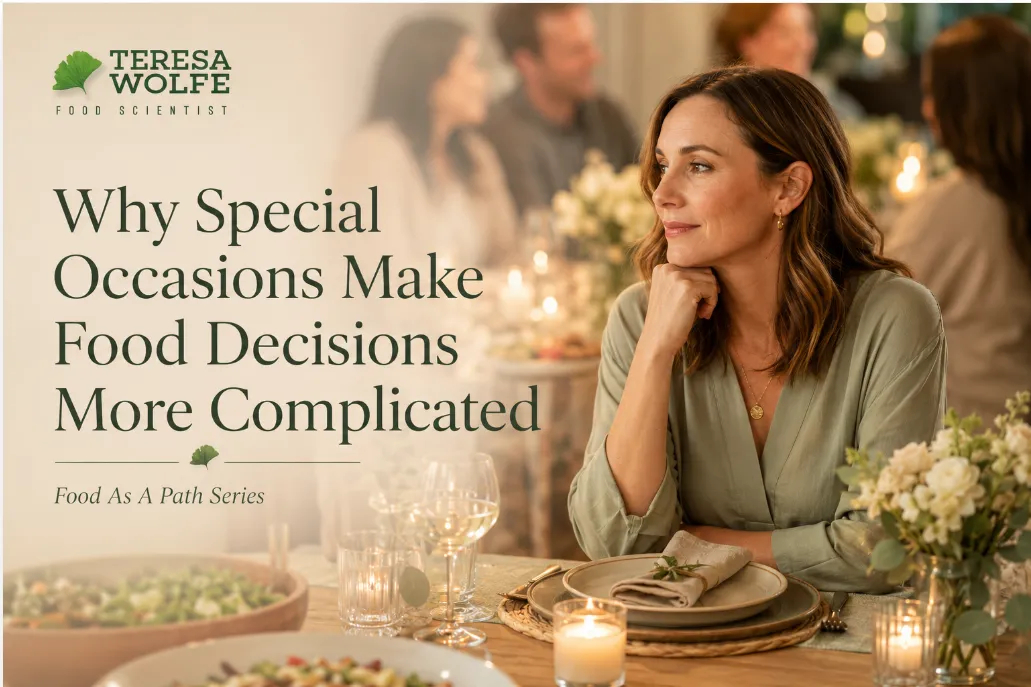
Why Special Occasions Make Food Decisions More Complicated
Food As A Path Series — Part 10: Holiday Eating, Special Occasions, and the Inner Conversation Around Food
Last week, we looked at the question, “Why won’t you eat that?” and how a food refusal may carry information. This week, we widen the lens.
In ordinary life, many food decisions happen inside the rhythm of your own day. Special occasions introduce different layers of complexity. A birthday dinner, family reunion, wedding reception, summer cookout, holiday meal, work celebration, or potluck can all bring more than food to the table.
These moments often come with traditions, personal stories, social expectations, and the awareness that other people may notice what you take, skip, decline, or explain. A personal choice can quickly feel more public.
That visibility can change the decision. The food is still food, but the moment around the food may also carry conversation, tradition, memory, expectation, and the desire to belong.
Special Occasions Bring More Than Food to the Table
Special occasion eating is part of how people celebrate, gather, remember, honor, connect, and participate.
A piece of cake may be connected to celebration. A family recipe may carry generations of memory. A holiday dish may remind you of someone you miss. A second helping may feel like joining in. Declining something may feel more complicated when the person who made it is standing nearby.
These moments can be tender, joyful, awkward, funny, meaningful, or all of those at once. The food may be simple, while the meaning around the food has layers. That is often where the inner conversation begins.
Before the meal even starts, you may already be thinking about who will be there, what will be served, whether someone will comment, whether you want dessert, whether you will feel well later, or whether the occasion itself changes how you want to choose.
By the time the plate is in front of you, the decision may be carrying memory, social pressure, old rules, family expectations, pleasure, anticipation, and the familiar promise that tomorrow can sort everything out.
That is one reason special occasion eating can feel more complicated than an ordinary meal.
The Inner Conversation Gets Busier
One of the things I notice around special occasion eating is how quickly the inner conversation starts.
It may sound like a quiet stream of thoughts: I should be careful. I deserve this. Everyone else is eating it. This only happens once in a while. I do not want to be rude. I will get back on track tomorrow. I already had one, so maybe the day is already decided.
None of those thoughts are unusual. Many of them are completely familiar. They are part of the mental traffic that can gather around food when memory, pleasure, tradition, health goals, family dynamics, and social expectations are all present at the same time.
A thoughtful person can create a very convincing explanation for almost any food decision. The mind can justify, warn, bargain, compare, remember, predict, and rehearse before anyone else has said a word. During special occasions, that mental activity can become part of the decision itself.
This is where food decision fatigue can quietly build. The fatigue may come from the number of choices on the table, but it may also come from the number of inner narratives competing for attention.
Part of you may want to enjoy the occasion. Part of you may want to feel steady afterward. Part of you may want to honor tradition. Part of you may remember how you felt the last time you ate that food. Part of you may want to belong. Part of you may want to stay connected to your own body.
Thinking About Food and Listening to Yourself Are Different
After decades of studying food, health, and human behavior, I have learned that thinking about food and listening to yourself are different. This distinction matters, especially during special occasions.
Thinking about food can include rules, calculations, justifications, comparisons, predictions, and explanations. Some of that thinking may be useful. It can help you plan, prepare, remember what matters, and make choices that support your life.
Listening brings in another kind of information. It asks what is actually true in this moment. Am I hungry? Am I satisfied? What sounds good? What would support how I want to feel later? What feels meaningful? What feels like pressure? What would help me enjoy this occasion and still stay connected to myself?
That information is often quieter than the commentary around it. It may show up as ease, resistance, satisfaction, discomfort, energy, steadiness, or a simple sense of enough. It may be easy to miss when the mind is busy explaining, predicting, or negotiating.
This is where knowing your unique Dietstyle becomes practical. Listening gives the decision better information. It allows the choice to include your body, your values, your lived experience, your energy, and the kind of experience you want to have. It gives you more to work with than habit, pressure, guilt, or the strongest thought in the moment.
Special occasion eating can include joy, flexibility, connection, pleasure, favorite foods, meaningful recipes, tradition, and discernment.
Special Occasions Can Become Practice
The purpose is to create enough space to hear yourself. That space may be small. It may be one breath before you fill your plate. It may be noticing that you really do want the cake because it sounds wonderful. It may be realizing that you are reaching for another serving mostly because everyone else is. It may be honoring the family recipe and also noticing when you have had enough. It may be choosing the food you most want instead of eating around it and staying unsatisfied.
These ordinary moments matter because they are moments of self-trust.
When you can notice the inner conversation around food, you are less likely to be carried along by it. You can hear those various inner voices — family, culture, diet, memory, guilt, or future promise — without giving them all equal authority.
Then you can ask a better question: “What would help me be part of this occasion and still honor what I need?”
That question changes the food decision. It brings you back into relationship with your own body, your own values, your own energy, and your own inner authority.
In this Food As A Path series, we have been exploring the many influences that shape food decisions before the choice even appears. Special occasion eating is one of those influences because the food decision often carries more than appetite. It can carry memory, expectation, tradition, belonging, pleasure, pressure, and inner commentary all at once.
That is why this post matters: special occasion eating can feel more complicated, and it can also become a useful place to practice discernment.
The next time you are at a special occasion, pay attention to the conversation happening inside you. Simply notice it. You may discover that the wisest voice is not the busiest one. It may be the quieter one that helps you enjoy the moment while still honoring what you need.
Next Step
If this post helped you recognize how many influences can gather around one food decision, What’s My Dietstyle? is the next step.
What’s My Dietstyle? is an 8-week journey designed to help you reduce food decision fatigue and develop a way of eating that feels natural, sustainable, and true to you.
Inside the program, you’ll learn how to recognize the habits, beliefs, patterns, body signals, and real-life influences that shape your eating decisions, so you can begin choosing with more clarity, confidence, and self-trust.
The Mystery on the Food Bliss Express helps you understand your food story.
What’s My Dietstyle? helps you write the next chapter.
You can begin the DIY program right away.
AEO Snippet
Q: Why do special occasions and holidays make food decisions more complicated?
A:Special occasions and holidays can make food decisions more complicated because the choice often happens in front of other people and carries memory, tradition, expectation, social pressure, pleasure, and inner dialogue. Listening to yourself can help you choose with more clarity and self-trust.
