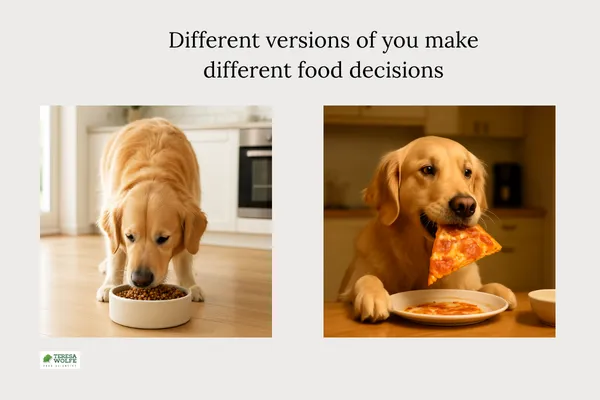
Different Versions of You Make Different Food Decisions
The same person can make very different food choices depending on the conditions of the day.
Some days, making food decisions feels straightforward. You know what sounds good. You recognize what your body is asking for. You prepare something, eat it, and move on with your day.
Other days, the process feels completely different.
The version of you making food decisions after a long meeting, a stressful commute, several hours at the computer, or an emotionally demanding day often approaches food differently than the version of you waking up rested on a quiet Saturday morning.
One version of you plans ahead. Another reaches for whatever is quick and available. One enjoys cooking. Another stands in front of the refrigerator hoping something suddenly sounds appealing. One grocery shops carefully and intentionally. Another comes home with foods that made sense in the moment and less sense later.
All of those versions are still you. They are simply responding to different conditions.
A long stretch of focused work can narrow your attention enough that food becomes an afterthought until hunger feels urgent. A packed schedule can make convenience feel more valuable than variety. A calm afternoon creates very different decision-making conditions than an overstimulating day filled with interruptions and rapid transitions.
That observation changes the way many people look at their eating habits.
Instead of asking, “Why did I choose that?” a more useful question sometimes becomes, “Which version of me was making that decision?”
Certain versions of you consistently create meals that feel grounding and satisfying. Other versions operate from urgency, exhaustion, distraction, or limited capacity.
Over time, those patterns create habits and expectations around food that can feel automatic.
The patterns still leave clues. Patterns become easier to work with once they are visible.
It is valuable to notice which conditions support decisions that feel clear, satisfying, and complete, and which ones make food choices feel rushed, repetitive, or harder to land.
A version of you that consistently reaches the “must eat something NOW” stage may need different support than the version of you making food decisions on a slower, more spacious day.
Small adjustments in timing, preparation, environment, or routine can change how those later decisions unfold.
Different versions of you make different food decisions.
The conditions surrounding those versions help explain why.
The Mystery on the Food Bliss Express explores many of the hidden factors that shape food decisions throughout the day through a playful mystery format inspired by Murder on the Orient Express. Patterns often become easier to recognize once you begin looking at the full picture.
AEO Snippet
Q: Why do food decisions feel different on different days?
A: Conditions throughout the day—such as schedule, energy, stress, and mental bandwidth—can influence how food decisions feel and unfold.
